From Scrolling to Seeing: How CUR8 is Rewiring the Way We Experience Contemporary Art
Picture this: you're scrolling, and a 15-second video makes you stop. No pompous art jargon, no distant institutional voice. Just a sharp, genuine recommendation that feels like advice from a knowledgeable friend, telling you why this specific exhibition is worth your Saturday afternoon.
This friend is Arthur Hadade, co-founder and CEO of CUR8*. He noticed a paradox. Contemporary art has never been more open, with free galleries and wide-open doors, yet it still feels illegible. The language of the art world often acts as a gatekeeper, making welcoming spaces feel intimidating.
CUR8 was built to shatter that aura of intimidation and exclusivity, dismantling the feeling that you need insider knowledge or a deep wallet to belong there. But let's be clear: the goal isn't to dumb down the art. The mission is to simplify the path to the works, and it's about making access fluid.
For CUR8, your screen is a threshold, not a final destination. We sat down with Hadade to discuss how to democratize access without oversimplifying the discourse, and how to build a credible, human bridge between the art world's inner circle and the audiences of tomorrow who have been kept at arm's length for too long.
///
BJ: For readers discovering CUR8 today, how would you define the project in a few words, and above all, what gap or shortcoming were you initially trying to fill?
AH: CUR8 was born out of a rather personal frustration. I loved going to exhibitions, but I couldn't find any discovery tool that made me think: "this is made for me." There were, of course, agendas, listings, specialized media, and Instagram accounts, but nothing that truly combined good curation, a modern interface, a form of advice, and the ability to help me choose exhibitions that might match my tastes.
I often felt that contemporary art was much more open than people believe, but much less legible than it should be. Many galleries are free, many exhibitions are fascinating, many artists have very strong things to say—and yet, for a large part of the public, all of this remains difficult to approach.
CUR8 was born from this very tension. We want to become the most natural gateway to contemporary art: a place where you discover what to see, why to go, how to prepare for a visit, follow venues, and gradually build your taste and your own relationship with art.
The problem is not a lack of interest in contemporary art. It is rather a problem of access, landmarks, language, and trust.
BJ: You often point out that you did not come from the contemporary art inner circle. Is it precisely this outside perspective that allowed you to more freely identify certain blockages or biases in the milieu?
AH: Yes, I think that played a big role. Not coming from the inner circle probably allowed me to ask rather naive, but useful, questions. Why do some extraordinary exhibitions remain invisible to a large part of the public? Why does the language of art sometimes give the impression of protecting access rather than opening it? Why can galleries, which are often open and free spaces, be perceived as intimidating?
Over time, I have obviously learned a lot from the art world and its demands. I do not believe that an outside perspective is superior. But it can be fruitful if it remains humble. It allows you to see certain frictions that regulars no longer necessarily see.
What we are trying to do with CUR8 is not to replace mediators, critics, curators, or galleries. It is to create a contemporary interface between their worlds and new audiences.
BJ: You have explained that you prefer the term "democratization" over "vulgarization" of art, the latter sometimes seeming reductive. Is this, for you, a way to make art more accessible without oversimplifying the works or the discourses?
AH: Exactly. I am quite wary of the idea that we need to "simplify" art to make it accessible. Works do not need to be reduced. They can remain complex, ambiguous, sometimes uncomfortable. That is often what makes them strong.
What needs to be simplified, however, is the path to them. Giving the desire to enter. Giving a few landmarks. Creating a first hook. Saying: "you have the right to be here, you have the right to look, to not understand everything right away, to come back."
For me, democratization does not consist of lowering the standard. It consists of increasing the number of people who feel capable of engaging with that standard. That is very different. CUR8's role is to make access more fluid, not to make the works flatter.
BJ: CUR8 seems to arrive at a time when culture is being discovered differently: recommendations, short formats, communities, rapid circulation of information... Do you consider Cur8 as a media outlet, a curation tool, a cultural platform, or a bit of all of these at once?
AH: I think CUR8 is at the intersection of these three dimensions.
We have a media dimension, because we tell stories about exhibitions, artists, and venues. We have a curation dimension, because not everything is of equal value, and our role is also to choose, to guide, to prioritize. But a media outlet tells stories. CUR8 must also trigger a practice.
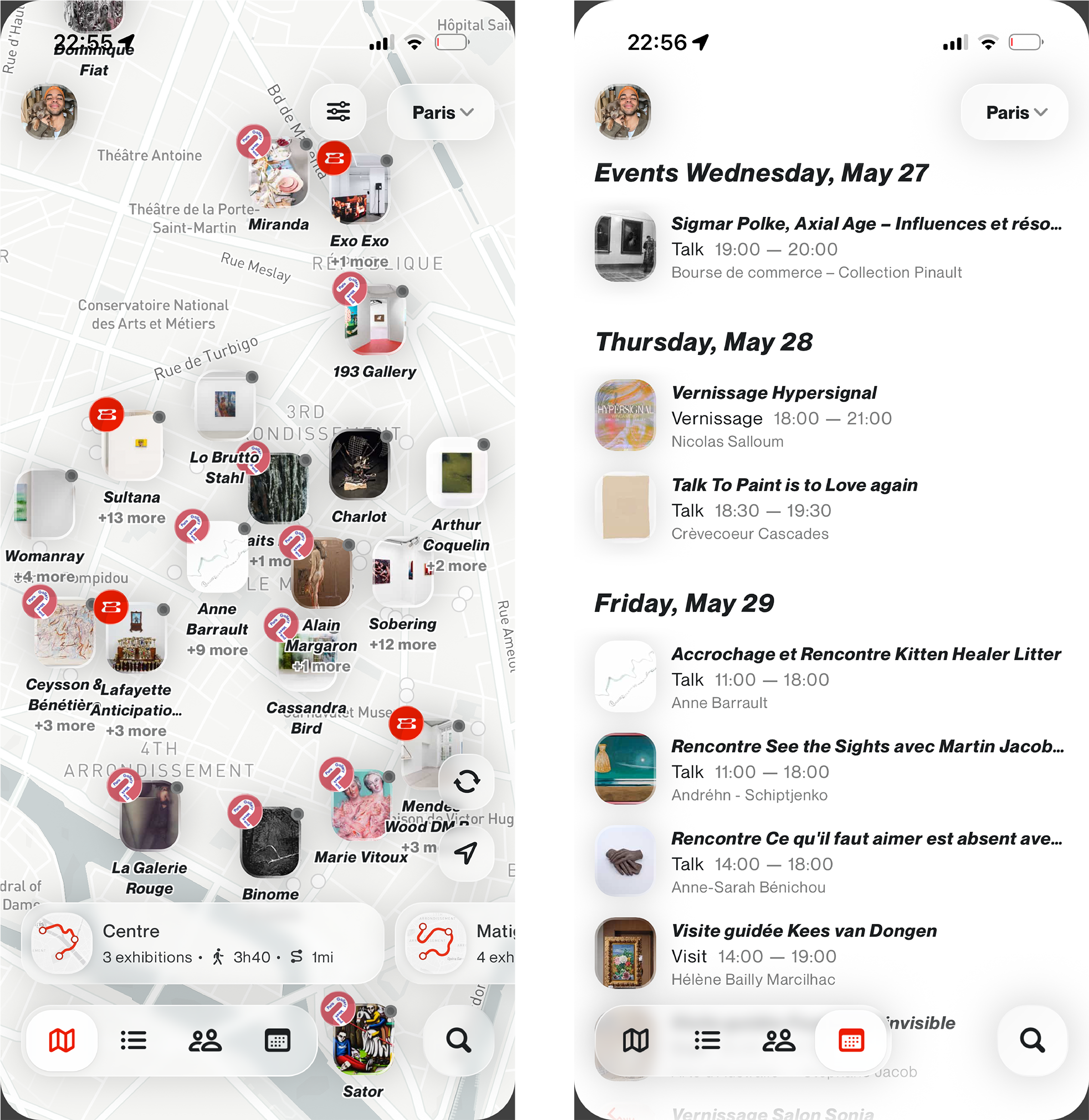
This is where the app is essential: it allows you to save an exhibition, prepare a visit, follow a gallery or institution, find what you have seen, and build a personal memory. And behind the scenes, for the venues, it allows them to better understand what this attention actually produces.
What interests me is the transition between these stages. Content can create desire. The app can transform that desire into a visit. The data can then help venues better understand the audiences they are reaching.
So I would say that CUR8 is not a classic media outlet, nor a simple exhibition guide. It is a discovery ecosystem, built to reconnect digital attention, physical experience, and a lasting relationship with art.
BJ: CUR8 is sometimes compared to platforms like Spotify or Strava, which have profoundly transformed the way people discover music or sports. But these models also raise questions about the speed of consumption or the standardization of practices. How do you prevent art discovery from slipping into a logic that is too fast or too uniform, and keep it qualitative?
AH: That is a real question, and I think we must be very vigilant. Art is not discovered the way one consumes an infinite stream of content. An exhibition requires time, travel, and mental availability. We must not lose sight of that.
What interests me in Spotify or Strava is not the logic of consumption. It is the way these platforms support a practice. They create landmarks, a memory, sometimes even an identity. Spotify does not replace music. Strava does not replace sports. In the best cases, these tools reinforce a practice.
That is what we are seeking with CUR8. We obviously do not want to turn art into something to be consumed faster. On the contrary: if CUR8 works, the app should help people take the time more often to go see an exhibition, to remember what they liked, to build their taste, to exchange with other people.
A good recommendation should not push you to move faster from one thing to another. It should make you want to stop at the right place.
BJ: Many galleries are today trying to reach a new generation of visitors or collectors, but few seem to really find the right language. Why does the art world sometimes struggle to adopt contemporary communication codes?
AH: Because it is a delicate balance. The art world has built part of its value on rarity, precision, relationship, slowness, sometimes even a form of distance. Contemporary communication codes, on the other hand, value immediacy, embodiment, repetition, and clarity. There is therefore a natural tension.
Some galleries fear that by adopting these codes, they will lose seriousness or desirability. That is understandable. But I think it is a false opposition. You can be demanding without being opaque. You can be contemporary in your communication without becoming superficial. You can speak to a new generation without mimicking its codes.
The real issue is not to "act young". It is to speak accurately to audiences who discover, look, decide, and travel differently. And that requires less slogans and more fine understanding of practices.
BJ: Your videos often give the impression that the exhibition becomes a narrative experience as much as a simple hanging. Today, must an exhibition also be "narratable" to exist in the digital ecosystem?
AH: I would not say that an exhibition must be "narratable" to exist. Some exhibitions precisely resist immediate narrative, and that is very good. But in the digital ecosystem, there often needs to be a narrative gateway to give people the desire to take the first step.
Telling the story of an exhibition is not reducing it to a simple story. It is identifying an angle, a tension, an atmosphere, a question. Why does this exhibition deserve that you leave your screen to go see it in person? What are we going to feel, discover, or understand differently on site?
Video is very powerful for this, because it can transmit energy, scale, and presence. But it never replaces the physical experience. On the contrary, the best content is what makes you want to go see for yourself. For me, the digital must be a threshold, not a final destination.
BJ: Do social networks also influence the way works are looked at, shown, or even selected? Do certain artists or exhibitions seem naturally more adapted to the current attention economy?
AH: Yes, of course. It would be naive to think that social networks have no impact on how works circulate, are perceived, or sometimes even installed. Certain forms are more immediately legible on screen: immersive installations, highly visual works, spectacular setups, images with strong narrative or aesthetic contrast.
But this is not necessarily negative in itself. The problem arises when the ability to circulate becomes the main criterion of value. A work can be highly shareable and very strong. It can also be very photogenic and quite poor. Conversely, some works less obvious to film can be profoundly striking in real life.
Our responsibility at CUR8 is precisely not to confuse visibility with quality. We use contemporary formats, but with curatorial demand. The challenge is not to push what performs best on a screen. It is to use the screen to create a path toward experiences that are worth living.
BJ: You now work with galleries, fairs, and institutions. How do you maintain a credible editorial eye while developing a business model and commercial collaborations?
AH: This is an absolutely central point. Our credibility rests on trust. If users feel that everything is purchasable, CUR8 loses its value. And if galleries feel that we do not know how to defend an editorial line, we also lose our value.
We therefore have a simple rule: curation comes before business. Working with galleries, fairs, or institutions does not mean accepting everything or presenting everything in the same way. We want to build collaborations that respect our perspective, our tone, and our community.
In reality, this is also in the partners' interest. What they come to CUR8 for is not just visibility. It is a form of credible recommendation to an engaged community. This credibility exists because we choose, because we prioritize, because we maintain a point of view.
The business model must support this demand, not weaken it.
BJ: Beyond visibility, how does CUR8 concretely support galleries, museums, and fairs in their communication, and what qualitative or quantitative feedback do you observe from them?
AH: We support galleries like Perrotin, Mennour, or Almine Rech, institutions like the Palais de Tokyo or the Bourse de Commerce, and fairs like Art Basel, on several levels.
First, we help them make their programming more visible and desirable, through the app, our video content, our editorial formats, and our recommendations. Today, CUR8 brings together over 70,000 users on the app, nearly 300,000 followers on social media, and a highly engaged cultural community, composed of amateurs, collectors, professionals, artists, curators, and prescribers.
But the subject does not stop at visibility. It is about the transition from an audience to a practice, and the measurement of real interest. Which audiences consult an exhibition? Who saves it? Who visits it? Who follows a venue? Which formats create engagement? How does an exhibition perform compared to other moments in the program?
This is important, because many cultural actors communicate a lot without always knowing what actually works. Our role is to help transform diffuse attention into more readable signals, and then into a lasting relationship with audiences.
BJ: During fairs or exhibitions like MAZE/Design Basel, what types of collaborations do you set up with galleries, and how does your platform amplify their visibility before, during, and after the event?
AH: During major events like a fair, our approach consists of working on three moments: before, during, and after.
Before the event, we must create desire. This involves content that makes people want to come, explains what not to miss, and makes the programming more legible. During the event, we must help visitors orient themselves, make choices, identify favorites, galleries, artists, or objects that deserve their attention. Afterward, we must prolong the relationship: allowing visitors to find what they saw, follow venues, discover other exhibitions, and sometimes continue a conversation with a gallery.
For MAZE/Design Basel, for example, we work on a selection of favorites. The idea is not to mechanically cover the entire fair, but to bring a perspective, a recommendation, a personal entry point. That is where CUR8 is useful: we do not just circulate information, we help create a discovery journey.
BJ: Many art professionals still struggle to measure the real impact of their digital communication. What types of indicators or feedback do you observe in the galleries that work with you?
AH: This is a central subject, because many digital metrics remain quite abstract. A view, a like, or an impression says something, but not necessarily whether someone has actually developed an interest in an exhibition, a gallery, or an artist.
At CUR8, we try to get closer to signals of intention, not just signals of visibility. A person who watches a video is a first level of attention. A person who opens an exhibition's page, saves it, follows the gallery, or declares a visit, is already something else. These are not perfect indicators, but they help answer a question many galleries ask themselves: who is actually interested in my program, beyond the circles I already know?
What also interests galleries a lot is knowing whether they are reaching audiences complementary to their usual ones: new visitors, future collectors, highly engaged amateurs, professionals, younger or more international profiles depending on the programs.
I believe the future of cultural communication will not just be about producing more content. It will be about better understanding what this content actually triggers: attention, visit, relationship, trust.
BJ: CUR8 was born in Paris but is now part of an international dynamic. More broadly, how do you imagine the evolution of the way new generations will discover and experience culture in the next five to ten years?
AH: I think cultural discovery will become much more hybrid, but also much more international.
New generations no longer really separate the digital and the physical: they discover an exhibition on a video, save it in an app, talk about it with friends, visit it on the weekend, and then follow the artist, the gallery, or the venue. All of this is part of the same continuum.
This continuum also goes beyond the borders of a single city. That is why CUR8 is building itself as a network of cultural cities: we were born in Paris, we are developing in London, we are present in several European cities, and New York will be our next major opening at the end of the year.
Contemporary art is global in its circulation, but profoundly local in its experience. You always discover from a neighborhood, a gallery, a fair, a meeting, a specific exhibition. Our ambition is to connect these two scales: helping a new generation navigate an international art world, without losing the very concrete quality of the on-site experience.
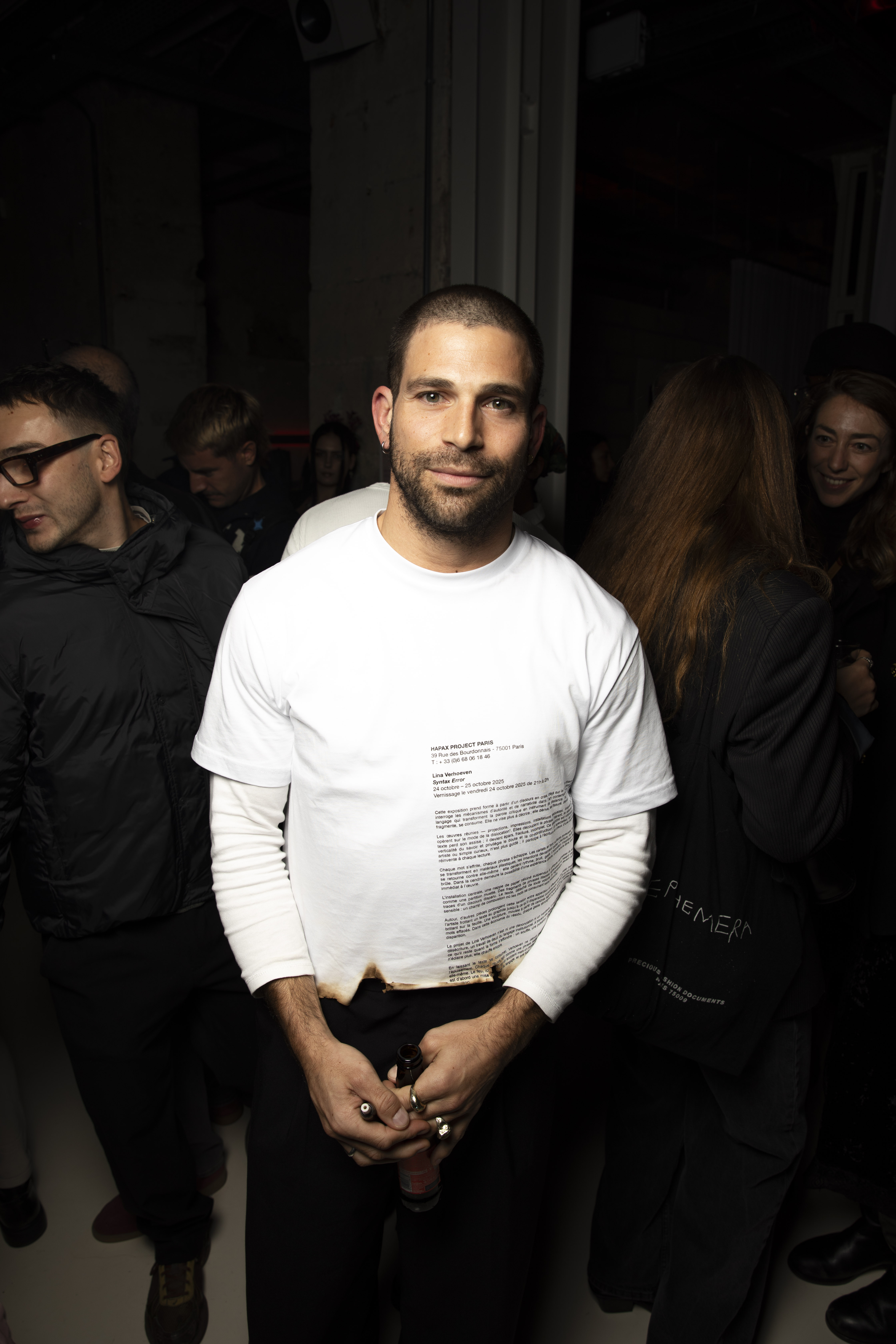
Photo: Dimitri Lanctuit
///
*CUR8 is a mobile app built around the promise of "a curated map of the best exhibitions around you." Available in Paris, London, New York, Venice, Brussels, and Madrid.
Website: CUR8
Download the app: HERE