.jpg)
Interview with Victor Fidelis
In November 2025, Victor Fidelis was awarded the inaugural MAZE/Art Award during Mira Art Fair in Paris. Trained in architecture and urbanism, the Brazilian artist has developed a distinctive visual language that explores intimacy, self-representation, and the complexities of contemporary Black identity in Brazil. Following this recognition, we spoke with Fidelis about his creative process, the influence of São Paulo on his work, and the evolving questions that continue to shape his practice.
///
BJ: How would you describe your creative process?
VF: My creative process is driven mainly by the visual stimuli of my everyday life. My earliest works, between 2020 and 2022, were a mixture of memories and family photographs. Over the years, as I gained experience and confidence in my production, I added to these inspirations more formal references — such as other figurative artists — as well as images from social media, and especially memories of scenes, places, and people I come across in my daily life.
BJ: Trained in architecture and urbanism, how does this background influence the way you think about space, composition, and structure in your work?
VF: Being an artist-architect is of great importance to my practice. My training in architecture and urbanism helps me mentally design scenes and imagine environments that support the narrative being told. I believe everyday life is full of sociocultural signs capable of expressing contemporaneity and Brazilian singularities.
The choices of colors, textures, objects, furniture, spatial arrangement, and the interaction of the figures portrayed with all of this stem from an architectural way of thinking.
BJ: You’ve mentioned being influenced by graffiti and street art, alongside classical Brazilian painters. How does this influence show up in your work today?
VF: São Paulo, my hometown, is deeply shaped by street art. In my adolescence, when I began developing my own drawing language, I was inspired by artists such as Os Gêmeos, Crânio, and Mag Magrela, whose visual languages engage with Brazilian tradition while innovating through contemporary themes.
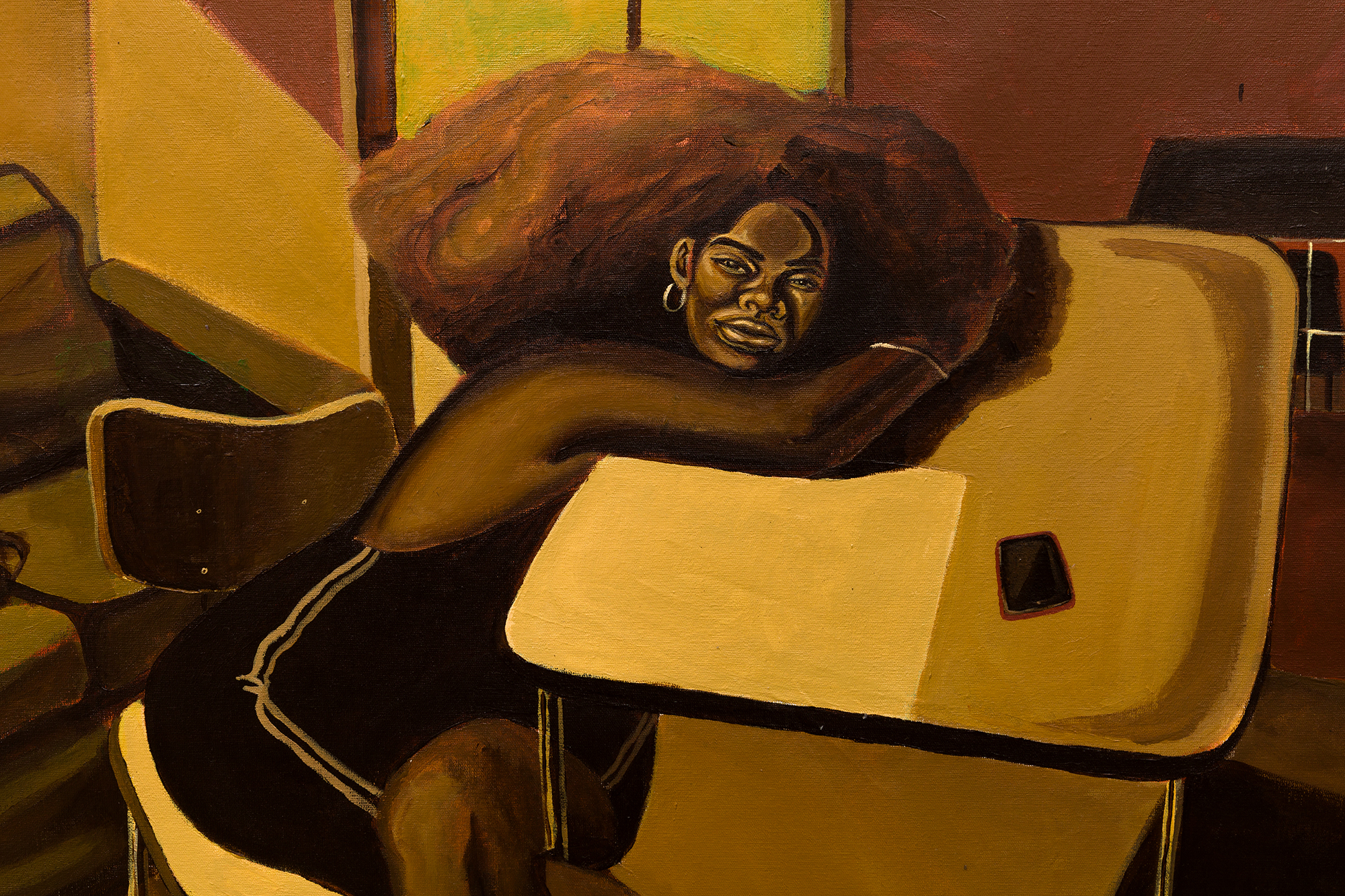
photo: Estúdio em Obra
BJ: You frequently use your own face and body through deformed or fragmented self-portraits. Why is self-representation important to you, and what does it allow you to explore?
VF: I believe that what distinguishes the current moment in Brazilian visual arts, with regard to the artistic production of minority groups, is self-representation. There is an unprecedented number of artists willing to address gender, race, sexuality, regional identity, and other social, cultural, and political aspects through their own experiences, across the many intersections of these issues. This helps expand the understanding of each of these themes.
Racial experience, for example, is not the same among Africans and diasporic Black people, among cis and trans individuals, among men and women, or among people from different economic backgrounds.
When I, within all the categories I inhabit — Brazilian Black man, from São Paulo, mixed-race, cisgender, gay, etc. — bring my own lived experiences into my work, I contribute to this expansion in a genuine way and with the authority of my own experience.
BJ: Many of your works focus on Black bodies, intimacy, and everyday life. Do you see your practice as a way of questioning or rethinking how these narratives are represented?
VF: The history of the representation of Black people in Brazil is deeply biased, especially within traditional arts such as literature and the visual arts. This stems from our position as objects of study and representation rather than as agents who produce narratives.
We have been confined to themes chosen through someone else’s gaze on Blackness, reduced to the experience of enslavement and its consequences — whether in the hardships of poverty and violence or in the exoticization, animalization, and hypersexualization of our bodies, as well as in stereotypes of cultural and religious aspects.
Portraying Black people from my own experience, using a drawing language that can be compared to Brazilian modernism — which greatly contributed to shaping both positive and negative notions of a Brazilian image — is, to some extent, a way of rethinking the narratives that have been imposed on us.
BJ: Could you tell us about the creation of No Limite do Privado? What was the most challenging part of this work?
VF: No Limite do Privado (At the Edge of Privacy) is an offshoot of the series Quando a Lua nos Sorriu (When the Moon Smiled at Us), shown in 2025 at the Centro Cultural São Paulo.
Over these years of production, I felt the desire to expand the settings in my work, moving beyond depicting only domestic and interior scenes to thinking about the external environment — the interaction of these bodies with the city, the external signs that mark Brazilianness, and how sunlight and shadow interact with these characters.
In a presentation talk for that series, I came to understand my work as an invasion of the subject’s privacy, which led me to explore the boundaries between private and public life: starting from the personal sphere, the limits between the characters; moving to the physical boundary between private and public space (walls, fences, gates, and other architectural elements); and, on a broader level, the boundary between traditional São Paulo buildings and mirrored towers — signs of internationalization.
The main challenges in No Limite do Privado were the relationship between human figures and setting — since my characters generally occupy a larger portion of the canvas — and the representation of sunlight. It portrays one of the streets in the neighborhood where I have lived since my twenties (I’m almost 32 now), and I’m happy to have brought it to fruition on canvas.
BJ: How is your relationship with works once they are finished? Do you see them as closed chapters, or do they continue to evolve in your mind?
VF: A few days ago, I read that every artist’s work is self-taught, because we learn as we practice our art. I constantly revisit my own production; there are always technical and thematic solutions still to be developed.
As soon as I finish a piece, I tend to be so focused on its technical flaws and successes that I hardly enjoy the finished work. Taking some time away and returning to it calmly, without the mindset of being in production mode, is important.
BJ: How would you say that your art has evolved over time? Was there a particular moment, project, or realization that marked a turning point?
VF: I come from a professional transition that happened by chance during the pandemic. Although I had been drawing for a long time and have training in technical drawing, painting only entered my life in 2020, during COVID.
As a result, the first milestones in my work were technical: my first painting, still on paper; my first works on cotton paper, which allowed me to create larger pieces with more paint; my first canvases, and so on.
Over the past two years, the milestones have been more about refinement — such as the volumetric rendering of fabrics or hair — and about expanding the representation of settings, architectural elements, and varied lighting conditions.
BJ: How does the city you live in influence your work?
VF: São Paulo is a metropolis that experienced rapid growth and is dynamic by nature. Its regions have disparate terrains, architectures, and infrastructures; we are highly influenced by the international context, and São Paulo’s culture is the sum of many others.
The portrayal of intimacy within the domestic context serves as a counterpoint to this agitation and to the potential violence of this environment. Within the domestic sphere, this chaos becomes a cultural marker of my hometown.
BJ: What are you currently working on, or thinking about next? Are there new directions, materials, or questions you feel drawn to explore?
VF: I’ve been thinking a great deal about representing Black bodies without the color palette I usually use. I also come from recent works that explore outdoor scenes through natural lighting.
Taken together, this has been guiding me toward a possible series of nighttime scenes, featuring artificial lights in different colors and darker, more chromatic canvases.
BJ: If you had unlimited means — time, space, and resources — what kind of artwork would you like to create? Would it remain intimate and drawn, or expand into a different scale or medium?
VF: Definitely, if I could expand my artistic skills, I would pursue sculpture. I am passionate about figurative art, and my work has a sense of volumetric construction that, in some ways, reminds me of bronze or dark wood sculpture.
Since my work deals with human bodies, I think it would be beautiful to see these characters at human scale, like those of Flávio Cerqueira or Nádia Taquary.
BJ: What question would you love to answer but no one ever asks you?
VF: One issue I think about is how not to become a prisoner of a narrative, theme, or style that is currently yielding results. Testing, making mistakes, and getting things right are all part of the process of studying and developing our research.
At the same time, we need financial return, which often makes us dependent — automatic producers. Being self-critical, yet gentle with oneself, and embracing the necessary changes to allow one’s work to flourish is a difficult exercise that should be more widely discussed and encouraged.
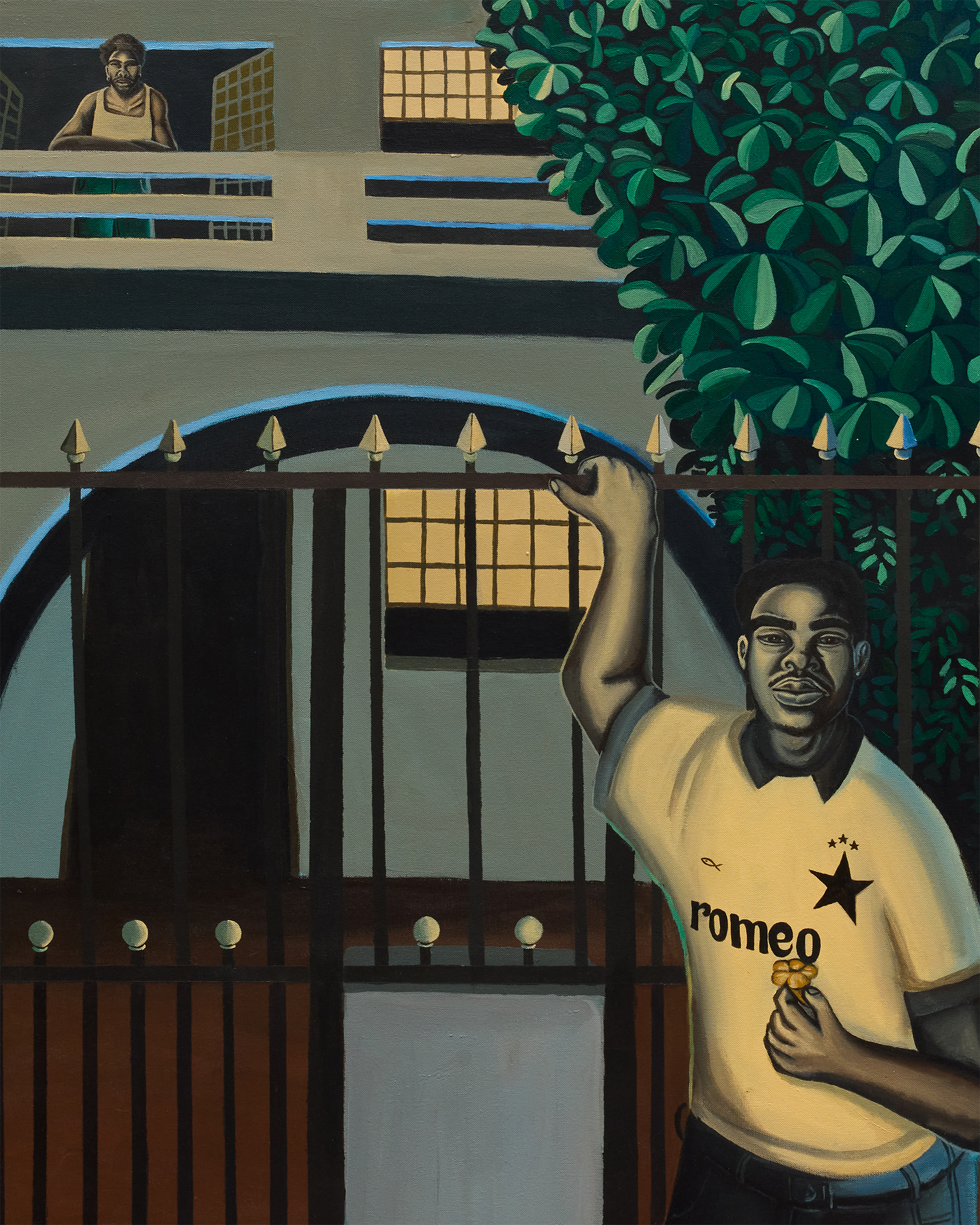
Photo: Estúdio em Obra
///
Photo cover: Portrait of Victor Fidelis, Acid.VK