Making Wroom – On Art and the Automobile
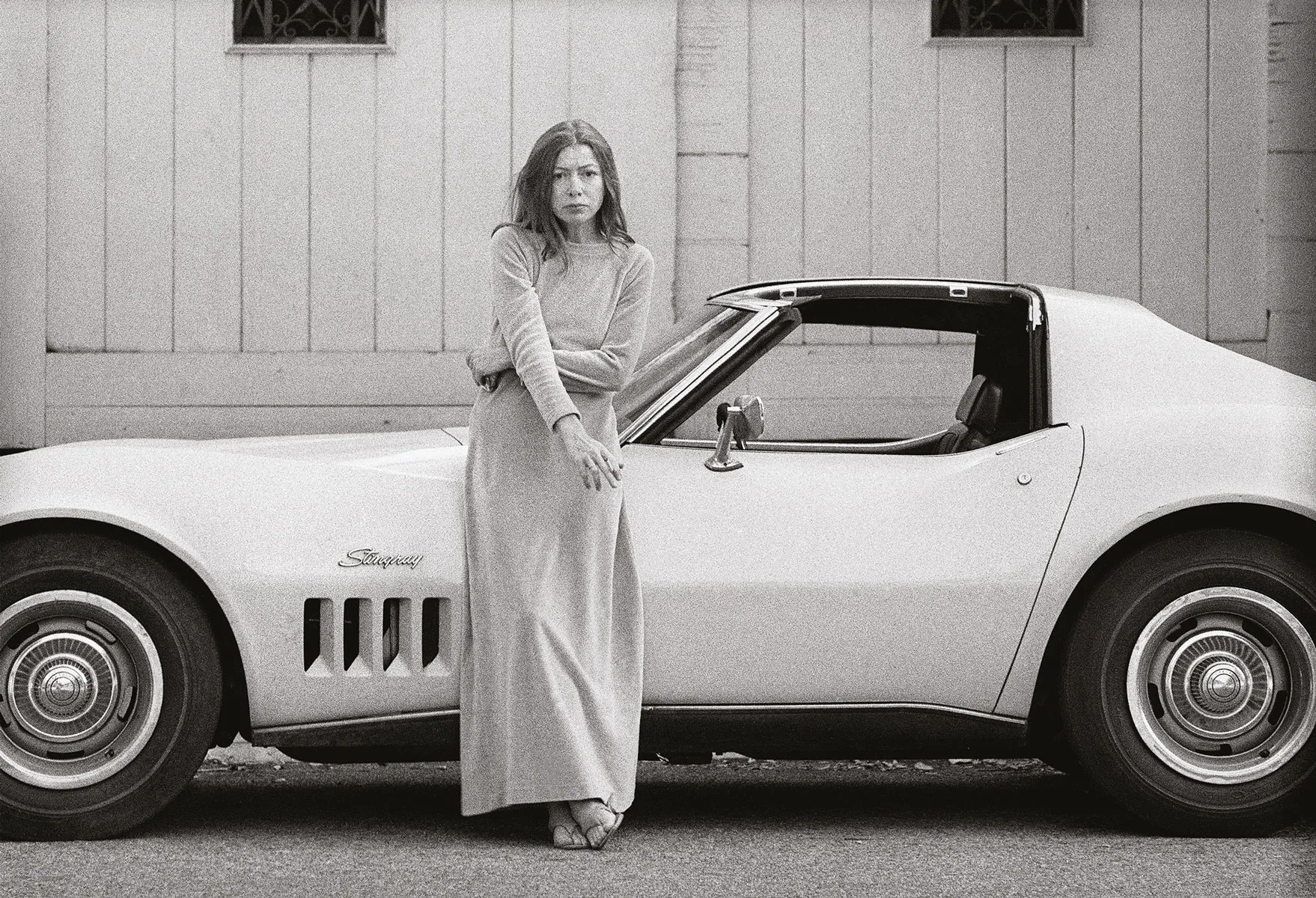
There is a famous picture of Joan Didion standing in front of her 1969 Stingray Corvette. Didion’s writing, in her widely read articles, essays and novels, was elegantly terse, precise and acerbic. And here she stands, a petite woman in floor-length flowing robe and sandals, smoking a cigarette and looking half cool and half worried, in front of a sports car with bulbous curves and shark-like gill slits. The photograph is in black and white, but we know that the car was yellow. It was obviously a sort of counter-intuitive, fuck-you fashion statement: the thoughtful, sophisticated author, and the loud, powerful, almost ridiculous- ly muscular car. The tension between the two is calculated to shoot arrows of desire, femininity/masculinity, sexuality, class, power, success, bohemian I-don’t- care, all of which point towards adventure. The photo marks an epochal moment in time, a pinnacle of a century in which the car increasingly had become, literally, the driving force of tropes of desire and freedom. But then came the “Limits of Growth” 1972 report by the Club of Rome, and the oil crisis of 1973. And these were not just bumps in the road, but eerily accurate premonitions of the 21st century and its increasingly, achingly clear problems with energy, with climate, with democracy, with sanity. If Didion’s Stingray moment is characteristic of 1969, another photograph, taken on January 1, 2025, is maybe characteristic of our mo- ment: a Tesla Cybertruck burst into flames in front of the entrance to the Trump Hotel in Las Vegas.
But how did we get there? And what role does art – visual art, but also writing, music, film, often in combination, if not unison – play in the establishment of dreams on wheels, of the incredibly powerful myth of the automobile? For these dreams were fueled right from the outset as part of the modernist movement. In his “Manifesto of Futurism” of 1909, Filippo Tommaso Marinetti had numbered points, the first of which expressed the intention to glorify “the love of danger, the custom of energy, the strength of daring”, while already the fourth point directly
referenced the car: “We declare that the splendor of the world has been enriched with a new form of beauty, the beauty of speed. A race-automobile adorned with great pipes like serpents with explosive breath.” Marinetti’s flavor of futurism already came with the acidy-metallic tinge of hyper-masculinism, and what was soon to become fascism. But one should not write this celebration of danger and speed off as merely some sort of early embarrassing accident on the road towards the Modernist Avantgarde revolution. Instead, it explicitly formulated a new, aesthetically extrapolated enthusiasm that is tapped into now and again to this day: The aplomb of the fast machine that, at the drop of a hat, transforms you into a kind of demigod.
It was already in the 1830s that the experience of moving on a smooth asphalt surface was first established, when the Champs Elysées in Paris was paved with large asphalt plates. This was the same place where, late on a summer evening in 1924, Le Corbusier experienced the epiphany of his troubled relationship to the street. At first, he describes his bitterness about losing the quiet of the street to automobile traffic: “I think back twenty years, to my youth as a student: the road belonged to us then; we sang in it, we argued in it, while the horse-drawn omnibus went gently by...“. Yet then, fighting his way through the crowd as if a car could run him down at any moment, he suddenly is converted to the church of the automobile: “I was assisting in the titanic rebirth of a new phenomenon... traffic. Cars, cars, fast, fast! ...The simple and naive pleasure of being in the midst of power, strength. One participates in it. ...One believes in it.”
Le Corbusier became the proud owner of a Voisin C7, built by the engineer Gabriel Voisin, who insisted on the functionality of car construction. In 1925, Voisin financially supported Le Corbusier’s ambitious plan for urban housing in Paris, Plan Voisin. It involved 18 skyscrapers spread out over an even landscape of streets and parks. The plan was never realized, but it set the paradigm for numer- ous similar later designs and realizations in the 20th century.
One of the most persistent reflections of the implications of this early modernist era of cars occurs in the work of German artist Michaela Melián. She has made work around female role models in early Modernism, and one of them is Swiss writer and photographer Annemarie Schwarzenbach, who was lesbian and fiercely anti-fascist, and who in the 1930s made several long-distance car trips: for example in 1937, she and Swiss sportswoman and travel writer Ella Maillart
drove together from Geneva via Istanbul and Tehran to Afghanistan in a Ford V8 91 A Deluxe. Melián also made an entire circle of works around Bertha Benz, who famously in 1888 was the first person in history to drive a combustion-engined automobile over a longer distance, from Mannheim to Pforzheim (a distance of 105 km). Bertha Benz, Konstruktion (1998-99) is in fact based on the silhouette of a Mercedes Benz S-Class 1990s model 140. Beneath a flesh-colored satin cover sits a life-size, simple wooden skeleton of the bodywork supported by trestles, not wheels. It looks more like a simplified child’s drawing than the actual bulky bullet of a limousine. The entire design is reminiscent of a slightly suggestive underskirt, as if covering a brutish Rococo crinoline. Through this quasi-surrealist conjoining of skirt and car, Melián hints at the gender-related libidinal charge of the histo- ry of the car – when Bertha had finished her journey, she had actually done her husband Carl a huge favor. He had put all of her marriage dowry into constructing his “Benzine”, but hadn’t manage to make it run properly for a longer distance. So her stubborn intervention contributed the missing link: she proved it was possible, and by way of that also now the motor was run in. Carl Benz could proud- ly present his automobile at the Munich World Exhibition – and christened it Bockige Bertha (Muslish Bertha). But Melián’s design of a satin-covered car sil- houette is also playing on a particular incident in 1998, when the work was first conceived: in a Paris underpass, Diana Princess of Wales had died in a Mercedes limousine, in the wake of which, for one week, Mercedes dealers covered their showroom S-class cars with dark-grey cloth.
Tragedy, drama, adventure, comedy: film history is awash with stories told with and through the car. And the history of cars in visual art cannot be understood without it. Maybe the first truly modern car chase scene occurs in Fritz Lang’s 1933 The Testament of Dr. Mabuse, with fast-moving car headlights eerily scan- ning night time trees, an image that Hitchcock might have been inspired by for the Ingrid-Bergman-driving-drunk scene in Notorious (1949). The idea of put- ting Cary Grant next to a recklessly driving beautiful woman occurs again in Hitchcock’s To Catch A Thief (1955), with Grace Kelly behind the wheel of a metallic-blue 1953 Sunbeam Alpine MKI, being chased by the police, driving along the Grand Corniche, the scenic road from Nice to Monaco (tragically, in 1982 Kelly died after suffering a stroke while driving in that same area).
As much as the car chase is a central convention of cinema, so is the road movie: the automobile as a kind of moving camera of the windshield (and the rearview
mirror), moving along a sometimes twisted, but ultimately linear route, turning into an allegory of the long and winding route of life itself: growing up, getting away, running out of gas, turning into cul-de-sacs, but then eventually into the sunset – or flying into the abyss (as both in Jules et Jim of 1962, and Thelma & Louise of 1991). And there is also the genre of the car race movie, maybe most iconically captured by two films from the same year 1971: Two-Lane Blacktop, a gritty story about drag car racers, and Le Mans, the Steve McQueen vehicle about the famous race of the same name.
A long-time motto of the film industry has been “Kiss kiss, bang bang”, first used by the Japanese press in the Sixties to describe James Bond movies, which equates with how Jean-Luc Godard spelled it out, in turn attributing the quip to D.W. Griffith: “all you need to make a movie is a girl and a gun“. Both in reference to Bond and Godard, one might want to add: “Kiss kiss, bang bang, wroom wroom” – because it’s the car which in many movies is literally providing momentum for that formula. Bond obviously is catering to the little-kid desire for gadget cars (the Aston Martin DB5 with ejection seat and custom machine guns etc.), while Godard is transplanting the American getaway car myth – cypher of masculine freedom – to France, with Jean-Paul Belmondo stealing a ’56 Oldsmobile, and later cruising around Paris with Jean Seberg in a ’55 Thunderbird, also stolen, for A Bout de Souffle (1960). Of course, Godard’s sardonic humor will not stop there: for Pierrot le Fou (1965), the Swiss director used an abundance of red cars (Alfa Romeo Spider, Autobianchi Primula, Peugeot 404, Renault Ondine, etc.), while in Weekend (1969), the movie features what was then the longest tracking shot in film history, moving across an absurdly elaborated traffic jam. One famous scene is of a horrific accident, the cars crashed into another, turned upside down, burn- ing (the Alfa Romeo burning in the middle was Godard’s own, a 2600 Sprint). A woman crawling from the car, to the sad soundtrack of elegiac strings, screams at the top of her lungs, as if she had just lost a leg: “Mon sac! Mon sac de Hermès!”.
If any artist has ever been seen as the one turning the car crash into heavy, achingly beguiling, almost aggressively beautiful sculptural form, it’s John Cham- berlain. Ironically, he himself has always rejected the idea that his objects cre- ated from twisted automobile parts, often including brightly colored car paint, had anything to do with car crashes – a long 1972 interview in artforum does neither include the word “car” nor the word “crash”. Instead, he insists they have no such metaphorical reference, but are “self-portraits”. It’s actually understand-
able, against the background of a discourse around Minimal and Post-Minimal Art focusing on abstract discussions of volume in relation to space, that he tried to steer clear of the loaded narratives of desire, violence and death connected with figures such as James Dean, or Jackson Pollock, both of whom died in car accidents. However, he also acknowledged that the way he intricately assembled junkyard scraps into something forming a new constellation that fits, like pieces of a puzzle that hadn’t existed before this act, had at least initially something to with the “force of the anger” he felt at the time. Thanatos and libido, status and gender, it seems, are factors hard to deny when it comes to dealing with the rela- tion between art and automobile, and it’s as if J.G. Ballard’s novel Crash, published a year after the aforementioned interview, is perversely spelling out the sexual charge, in the story around a group of fetishists conflating machine functionality with bodily sensation, getting aroused by the prospect of dying in a celebrity car crash (David Cronenberg adopted the novel for his eponymous 1996 film).
Chamberlain certainly isn’t the only one amongst his generation of artists who emerged in the 1960s to have found central inspiration in the car. In the case of Tony Smith and Ed Ruscha, it’s rather the driving of the car, its relation to the mod- ern industrial landscape, that is at stake. Sculptor Tony Smith has often described one experience he had in 1951 as his epiphany ( first in 1966, in an interview with artforum), about reaching a then-unfinished part of the New Jersey Turnpike near New York city: “It was a dark night and there were no lights or shoulder markers, lines, railings, or anything at all except the dark pavement moving through the landscape of the flats, rimmed by hills in the distance ... This drive was a revealing experience. The road and much of the landscape was artificial, and yet it couldn’t be called a work of art. On the other hand, it did something for me that art had never done ... its effect was to liberate me from many of the views I had had about art ... the experience on the road was something mapped out but not socially recognized. I thought to myself, it ought to be clear that’s the end of art. Most painting looks pretty pictorial after that. There is no way you can frame it, you just have to experience it”. Some critics such as Michael Fried took this insistence on “...you just have to experience it” as an indication that there was a problem with Minimal Art, that it somehow propagated a false immediacy. But if there ever was a problem, Ed Ruscha’s epiphany did away with it. In his case in 1956, at the age of 18, he took his first road trip from Oklahoma to Los Angeles. The experience lead, in 1963, to the iconic artist book Twentysix Gasoline Stations, a registering
of the gas stations along that route with simple front photographs, set in a sober black and white layout. It was a disarming, deadpan counter-act to the techni- color glamorization of the road movie trope.
One could cite many more examples of such seminal work dealing with the Amer- ican (and French) movie- and novel-related paradigm of the car and the road and driving, whether in art or in pop music ( from the Beach Boys’ “Fun, fun, fun, till her daddy took the T’bird away” to Kraftwerk’s “Fahren, fahren, fahren, auf der Au- tobahn”). And it remains to be seen how artists can still wrench new insights from those stubborn chunks of steel, now often with heavy sets of lithium batteries, that populate our cities. Sylvie Fleury has picked up on the aforementioned con- nection between the car myth and the supposedly anti-mythic Minimal tradition, by exposing its masculinist streak with a feminist sense of glamour and irony, as with her car wreck coated in a glaring Givenchy pink nail varnish (Skin Crime 3 (Givenchy 318), 1997). And the crashed car has also returned in different forms, from Bertrand Lavier’s readymade, or rather as he calls it “ready-destroyed” wreck of a red Ferrari Dino 308 GT4 (Dino, 1993), to the late Gustav Metzger, whose in- stallation Kill the Cars of 1996 includes photographs of an anti-car demonstration in London of that year, and a demolished car; for each time the work is shown, a new wreck is put in the exhibition space.
In recent years, a younger generation of artists has taken up the gauntlet of celebrating slash destroying the car while not simply giving in to its industry allure. Just four examples from Berlin (and all female, incidentally), from the last couple of years: in the Summer of 2023, Selma Selman showed her work Platinum (2021-23) at Hamburger Bahnhof Museum in Berlin: it involves a car being dissected like a carcass (in collaboration with members of her Roma family in Bosnia-Herzegovina, who earn a living with scrap metal dealing), be- fore the valuable precious metals included in the catalyst of the car are isolated – with the resulting objects having been turned into sculptures put on display. In August 2023, Austrian artist/choreographer Florentine Holzinger staged a 20-minute spectacle in front of the entrance gate to Berlin’s Olympic Stadium. Titled (Scrap-Etude): An Etude for Extinction, it involved, amongst numerous other elements, a mint-green BMW circling on two of its four wheels around a mobile crane, and Holzinger sticking naked out of the passenger window, playing a violin bow on the side mirror. Göksu Kunak, in September 2023, staged her performance Venus on the steps in front of Mies van der Rohe’s Neue
Nationalgalerie. A black BMW became the locus of queer and hypermuscular bodies, with blaring Turkish rap from the speakers, all of which functioned as an offer to social media phone coverage. And finally in October 2024, visual artist Agnieszka Polska staged her 90 minute The Talking Car, her first stage produc- tion, at HAU Berlin; it involves people stuck in an autonomous driving car – a kind of darkly glittering SciFi-metaphor for our contemporary moment.
What all of these projects – and especially Holzinger and Kunak – seem to have in common is a desire to critically subvert the oily bruteness of car culture – while they also inevitably perpetuate it precisely through such actualizations, against the background of a more sanitized-seeming digitized car culture of the future (that Polska put center stage). Is there a possible way out of that double bind of subversion-as-fetishization, or of dystopia-as-utopia? Maybe a 2007 com- mission to Olafur Eliasson in the BMW Art Car series already forbode at least one way forward. Instead of simply covering the car in some signature design – as did Andy Warhol, Robert Rauschenberg before, or Julie Mehretu after him – he turned it into an immobile and ephemeral sculpture. He presented his version of the H2R hydrogen car – a racecar developed in 2004 to run on liq- uid hydrogen – in a cooling chamber: now it looked as if the prototype fell off a container ship in the North Atlantic and got caught in a holey fishing net before being shock-frozen in Superman’s ice palace. It was as if the net had formed a hilly landscape with craters and mini stalactite grottos on the vehicle, rebuilt on its chassis. In any case, the racecar is no longer simply futuristic: it is now more as if not the car, but the room in which it is located, is set in a distant future in which it is kept as a relic of a lost era. At the same time, it is absorbed into Eliasson’s elegant artistic idiom of the transparent interlocking of technological, spatial and natural experience. His experiment seemed to put the car per se into something like a pupal state, a shock-frosted cocoon of ice, as if to ask: What will emerge from this one day?
///
Jörg Heiser is a critic, curator, and Director of the Institute for Art in Context in Berlin. For twenty years, he worked on the editorial board of frieze magazine. His first car was a frog-green 1974 VW Beetle 1303, the last worth mentioning a creamy white 1989 Chevrolet Caprice Classic Sedan.
Photo cover: Julian Wasser, Joan Didion in front of her Stingray Corvette (1968), courtesy of Alexi Wasser